Confused about cricket’s DRS? Here’s everything fans need to know — how it works, when reviews can be used, the tech behind it, and how this system has transformed the sport forever.
🧭 What Exactly Is DRS in Cricket?
Every cricket fan knows that feeling — the ball hits the pad, players go up in appeal, the umpire says “Not Out,” and suddenly the fielding captain makes a “T” shape with his hands. That’s the Decision Review System, or DRS.
DRS is cricket’s way of using technology to review umpire decisions. Introduced in 2008, it has now become part of almost every international match. Its main purpose? To minimize human error and ensure fairness, especially in high-stakes games where one wrong call can decide the match.
From test arenas to IPL nights, DRS has changed the way both players and fans experience the game — blending emotion with precision.
⚙️ How DRS Works: Step-by-Step Breakdown
The DRS process might look complicated, but it follows a clear sequence:
- On-Field Decision:
The umpire gives a verdict — “Out” or “Not Out.” - Team Challenge:
The captain (or batter) decides whether to challenge within 15 seconds. - Third Umpire Review:
- UltraEdge/Snickometer: Checks for sound when the ball passes the bat.
- Hot Spot: Uses infrared cameras to detect ball impact.
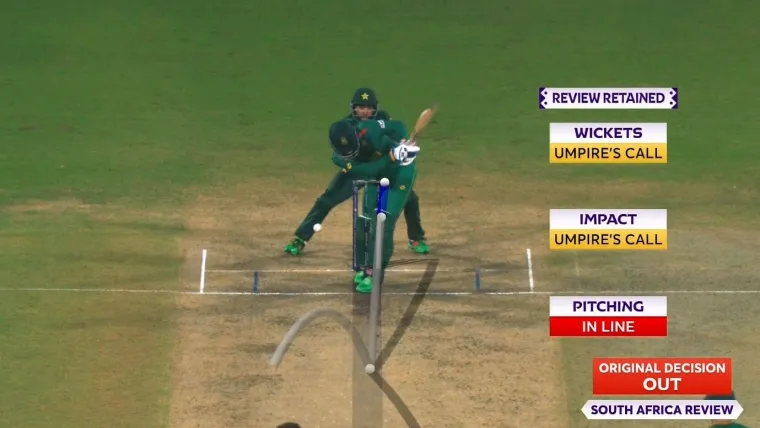
- Hawk-Eye: Predicts the ball’s path to assess LBW decisions.
- UltraEdge/Snickometer: Checks for sound when the ball passes the bat.
- Final Verdict:
- If the evidence is clear → Decision is overturned.
- If not → “Umpire’s Call” stands.
- If the evidence is clear → Decision is overturned.
The “Umpire’s Call” rule often causes debate, but it’s crucial — it respects the on-field umpire’s authority unless the tech provides conclusive proof.
📺 Inside the Technology: The Science Behind DRS
Modern DRS relies on some of the most advanced sports tech available:
| Technology | What It Does | Key Benefit |
| Hawk-Eye | Tracks the ball’s 3D trajectory | Accurate LBW predictions |
| UltraEdge | Uses sound waves to detect edges | Catches faint nicks |
| Hot Spot | Thermal imaging shows ball contact | Visual confirmation |
| Real-Time Replays | Slow-motion video from multiple angles | Confirms catches or deflections |
These tools combine physics, AI, and camera precision, creating a near-perfect decision model. Hawk-Eye alone uses up to 6 cameras at 230 frames per second to track the ball.
⏱️ When Can Teams Use DRS?
DRS rules vary by format:
- Test Matches: 2 unsuccessful reviews per innings, refreshed after 80 overs.
- ODIs: 1 unsuccessful review per innings.
- T20Is: 1 review per innings.
If a review is successful, it doesn’t count against the team — but a wrong call can cost you your last chance later in the game. That’s why timing is everything.
🎯 Pro tip for fans: When a batter wastes a review early, it can haunt the team later — as seen in the 2019 Ashes Test at Headingley, where England ran out of reviews before Ben Stokes’ LBW scare!
🧠 Strategy: The Smart Use of DRS
A well-timed DRS can turn a match on its head. Top captains like MS Dhoni, Rohit Sharma, and Kane Williamson are known for their tactical brilliance with DRS.
How they get it right:
- Consult key players: Usually the bowler, wicketkeeper, and a close fielder.
- Avoid emotional reviews: Never challenge just to “try your luck.”
- Read patterns: Use match data and bowler feedback.
- Stay calm: Pressure often leads to rash calls.
MS Dhoni was nicknamed the “DRS King” for his uncanny accuracy — at one point, over 85% of his reviews were successful during international play.
🎯 Umpire’s Call: Why It Divides Fans
The “Umpire’s Call” is both fair and frustrating. It means that if Hawk-Eye shows the ball barely clipping the stumps — and the umpire said “Not Out” — the original call stands.
Supporters argue it keeps respect for umpires intact. Critics say it creates two different outcomes for identical deliveries.
The ICC has defended this rule, stating that no tracking technology can yet be 100% perfect, so human judgment must still play a role.
Still, fan debates over “Umpire’s Call” remain one of cricket’s most passionate talking points.
⚡ Iconic DRS Moments That Changed Cricket
- India vs Pakistan, 2011 World Cup Semifinal:
Sachin Tendulkar’s LBW was overturned via DRS — arguably the most famous review in cricket history. - Ben Stokes, Ashes 2019:
Survived an LBW shout because England had no reviews left. That match became an instant classic. - Virat Kohli, 2021 Chennai Test:
Used DRS perfectly twice to dismiss English batters, swinging the game India’s way.
Each of these moments proves how a single review can rewrite cricketing history.
💬 What Players and Experts Say About DRS
- Virat Kohli: “Technology helps, but the game should never lose its human element.”
- Ricky Ponting: “DRS has improved the accuracy of decisions massively — but it’s not flawless.”
- Ian Bishop: “The real drama of modern cricket now begins the moment a captain signals for review.”
Experts agree — DRS adds both fairness and thrill. It’s no longer just a tool; it’s a part of cricket’s theatre.
📊 How DRS Changed Cricket Forever
Here’s what DRS has achieved since 2008:
- Reduced umpiring error rates by over 25% (ICC stats).
- Increased fan engagement — reviews add drama to live telecasts.
- Encouraged transparency and accountability in umpiring.
- Enhanced broadcast experience with slow-motion and replays.
However, technology hasn’t killed emotion — if anything, it’s amplified it. Every “Waiting for decision… OUT!” moment sends chills across stadiums and living rooms alike.
💡 Fan Emotions: Why We Love and Hate DRS
For fans, DRS is an emotional rollercoaster:
- The suspense of watching the replay.
- The tension of waiting for “Ball Tracking… Impact in line…”
- The roar (or groan) when the verdict appears.
It’s not just about fairness — it’s about the experience. DRS moments trend on Twitter, fill meme pages, and dominate post-match discussions.
That’s why DRS controversies often go viral — they combine tech, tension, and human drama in a way few sports can match.
🌍 The Future of DRS
With AI and computer vision advancing rapidly, the next decade will bring even smarter review systems:
- Real-time automatic edge detection
- 3D ball path visualization in augmented reality
- AI-based predictive umpiring
Some leagues are already experimenting with player-call DRS (like in The Hundred), where batters can initiate reviews themselves.
As technology evolves, cricket will likely become even more transparent — but the tension and unpredictability will remain the same.
🏁 Final Over: The Balance Between Human and Machine
DRS isn’t perfect, but it’s revolutionized cricket’s fairness and drama. It bridges the gap between emotion and accuracy, allowing fans to experience every angle, every edge, and every heartbeat of the game.
As the game continues to evolve, one thing is certain — every time that “T” signal goes up, the world holds its breath.
Because in that moment, cricket becomes science, suspense, and spectacle — all at once.